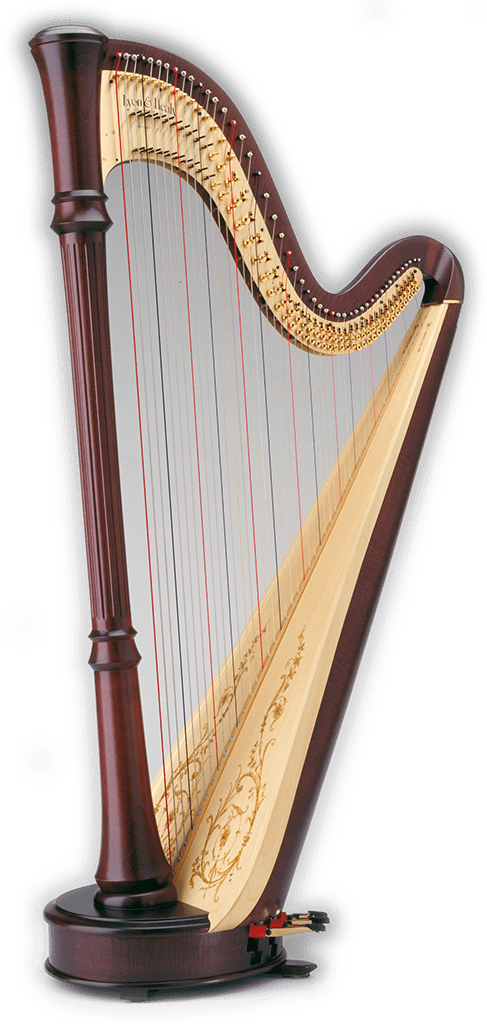
Also called folk harps or troubadour harps, lever harps are distinguished by the "lever" mechanism that lets you change the pitch of each string. Most of our Celtic lever harps have sharpening levers on each string; certain models only have levers on C's and F's. More levers lets you play in a wider range of keys without re-tuning strings.
Our Celtic harps are generally styled after the traditional Irish harp made popular in Ireland centuries ago. These harps are easy to play and have a lower string tension than our so-called "classic" lever harps. Our classic lever harps are more suitable for someone who is likely to go on to pedal harp some day and are described on our Classic Lever Harp Page.
The Harp Connection offers Celtic harps in a huge range of sizes, from 26 to 38 strings, many different kinds of woods and soundboard and body ornamentation. Unlike our classic lever harps, which are all made of maple, Celtic harps can be made of walnut, cherry and more exotic woods like bubinga. If you are not sure which harp is best for you, we hope you can visit our showroom or call us and we can help you find the harp of your dreams. We also have a terrific Rental Program to make getting started or trying a different harp easier.
You can click or tap on the image of any harp to see a high-resolution photograph of that harp in a separate window. Our in-stock inventory is listed on the individual Celtic harp pages. Our web site includes short videos of all the Celtic lever harps made by Dusty Strings; you will find links to the videos on our individual harp pages.
Available both in a full-stave model 'FH36S' and a Hybrid-Stave model 'FH36H' (this design puts a flat facet, rather than a corner against the player's shoulder which some find more comfortable. This model also gives an overall rounder sound, with a slightly fuller bass voice.) Comes fully levered and includes a deluxe carrying case and tuning key. Shown in Bubinga. Other woods: Sapele, Maple, Walnut, and Figured Cherry. 5 year limited warranty for new harps. Hide Details.
The FH34, Dusty's compact, 4-3/4 octave, all-solid-wood model, delivers brightness, depth, and clarity along with both portability and range. Now also available as a lightweight FH34S staved back model. Includes a carrying case and tuning key. Shown in Figured Cherry. Other woods: Maple, Sapele, Walnut and Bubinga. 5 year limited warranty for new harps. Hide Details.
A more affordable version of the FH34, the Crescendo, uses a simpler soundboard construction technique, has a resonant and clear sound. Comes fully levered in Sapele. 4¾-octave range C to A. Solid Sapele body and neck; laminated Finland Birch soundboard. Includes a tuning key and deluxe case. 5 year limited warranty for new harps. Hide Details.
The Ravenna 34 is full-range, affordable instrument designed for the discerning and cost-conscious harp enthusiast. Comes fully levered and includes self-contained extendable leg, tuning key and carrying case. Standard finish is Black Ash. Other finishes: Black, Green, and Burgundy. 2 year limited warranty for new harps. Hide Details.
This 26-string, 3-1/2 octave all-solid harp is fully levered and has a sweet and strong voice. Matching legs and deluxe case included. Shown in Figured Cherry. Other woods: Sapele, Walnut, Maple, and Bubinga. 5 year limited warranty for new harps. Hide Details.
The 26-string Allegro is an ideal and affordable instrument for the beginning harp player. Its 3-1/2 octaves make it conveniently portable yet provides enough range. Comes fully levered in Sapele with deluxe case. Solid Sapele body and neck; laminated Finland Birch soundboard. 5 year limited warranty for new harps. Hide Details.
The Ravenna 26 is an innovative, affordable instrument for the budget-minded harp player. Comes fully levered and includes self-contained extendable leg, tuning key and carrying case. Standard finish is Black Ash. Other finishes: Black, Green, and Burgundy. 2 year limited warranty for new harps. Hide Details.
*Price depends upon finish and options. Returns: We want you to be completely satisfied with your instrument, no questions asked. The Harp Connection offers a 30-day return policy on lever harps and lap harps purchased from our store (except special orders). To be eligible for return, the harp must be in the same condition as when we shipped it to you and it must be returned with all accessories such as tuning keys and books. In the event of a return, you will be responsible for return freight to our Rowley, Massachusetts location. Custom-ordered harps may not be returnable, depending on the requirements of the factory; call us with specific questions about special order returns. Pedal harps can only be returned upon approval of the manufacturer and a 20% return fee will typically apply. We update our web site daily, however all harps are subject to prior sale.



;)
;)
;)
;)
;)
;)
;)
;)
;)
;)
;)